
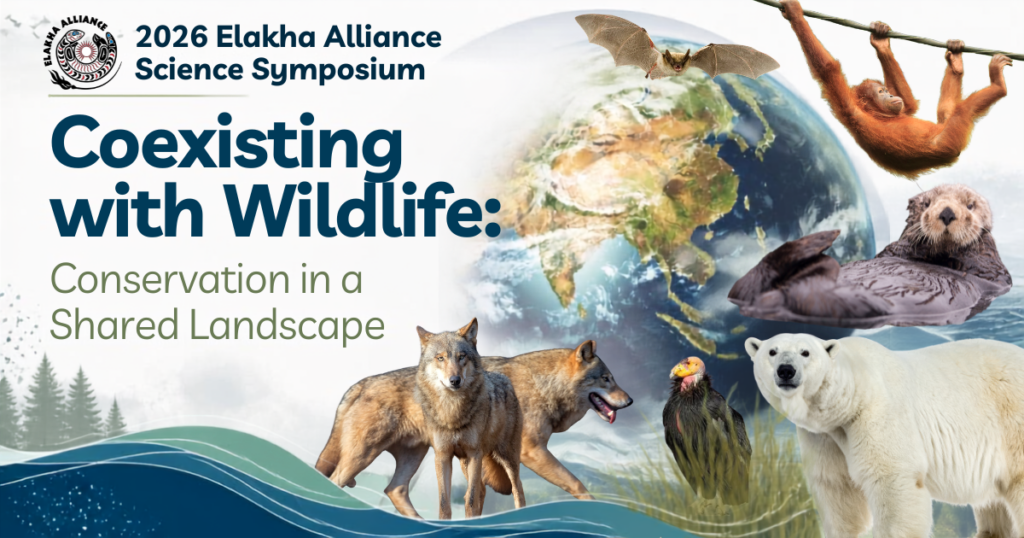
Save the date for this year’s virtual Elakha Alliance Science Symposium taking place from 9:00am-3:00pm PST on Wednesday October 21st.
The theme this year is: Coexisting with Wildlife: Conservation in a Shared Landscape
As human populations continue to grow and expand into natural areas, encounters between people and wildlife are becoming increasingly common. The future of conservation depends not only on protecting habitats and recovering species, but also on learning how people and wildlife can successfully coexist in shared landscapes and seascapes.
This year’s symposium explores the opportunities and challenges of living alongside wildlife. From restoring sea otters to the Oregon coast to reducing conflicts with predators, marine mammals, birds, and other native species, successful conservation requires collaboration among scientists, Tribal Nations, resource managers, policymakers, local communities, and the public.
Rather than viewing wildlife as something separate from our daily lives, this theme recognizes that healthy ecosystems and thriving human communities are interconnected. By sharing the latest research, innovative management strategies, Indigenous knowledge, and community engagement efforts, we hope to inspire thoughtful conversations about how conservation can benefit both people and wildlife. We’ve locked in seven outstanding speakers for this year’s Symposium, all rooted within the wildlife conservation field and coexistence.
Register here:
Event Details
AGENDA (PST):
9:00am – 10:00am: Building Bridges for Coexistence: Sea Otter Stewardship Across Communities and Coastlines, Heather Barrett (Sea Otter Savvy)
Sea Otter Savvy fosters coexistence between people and sea otters through science, education, stewardship, and community engagement. This presentation will highlight efforts within the sea otter’s current range to reduce human-wildlife conflict and support responsible stewardship, while exploring how community partnerships and dialogue can help build bridges to coastal communities where sea otters have long been absent.
10:00am – 11:00am: Building a World That Wants Wildlife to Thrive, Shervin Hess (Oregon Zoo)
From elephants in Borneo and polar bears in the Arctic to turtles, condors and eagles closer to home, the Oregon Zoo is reducing threats, mobilizing communities and bringing unlikely partners together. This talk explores how collaboration turns coexistence from an aspiration into action.
11:00am – 12:00pm: What Remote Scents-ing Can Tell Us About Wolf Predation on Sea Otters in Alaska, Kayla Fratt (K9 Conservationists) & Ellen Dymit (Oregon State University)
Sea otter populations have been growing in southeast Alaska for decades. A few years ago, biologists captured evidence that wolves will capture sea otters for food. Using detection dogs to collect wolf scat, we have revealed widespread consumption of sea otters in Alaska’s Tongass National Forest.
12:00pm – 1:00pm: KEYNOTE: Discovering Diverse Pathways to Inspire Conservation Behavior Change, Lily Maynard (Cincinnati Zoo & Botanical Gardens)
In this presentation, Lily will guide the audience to consider what motivates them to connect with diverse conservation messages and introduce social science tools to amplify strategies to inspire conservation action using a framework to explore diverse pathways to behavior change.
1:00pm – 2:00pm: Wildlife Services Program – Think Wild’s Strictly Humane Approach to Wildlife Coexistence Solutions, Jacob Sandler (Think Wild)
During the hour-long presentation, we will be taking time to dive into the varying humane exclusion techniques and habitat-based wildlife conflic
2:00pm – 3:00pm: Combining Traditional Knowledge with Western Knowledge as a Young Indigenous Scientist in Sea Otter Reintroduction, Gabriel Jurado (Hoffman Coexistence Science fellow with the Elakha Alliance and the Cincinnati Zoo and Botanical Gardens)
During this presentation, Gabriel will explore his identities as an Indigenous person rooted in culture as he navigates the scientific world and how Indigenous representation is critical in the pursuit of natural resource restoration for tribal communities. Additionally, he will explore his work in understanding tribal perspectives in sea otter reintroduction through his fellowship with the Elakha Alliance.
PRESENTER BIOGRAPHIES:
Heather Barrett, Director of Science Communication at Sea Otter Savvy
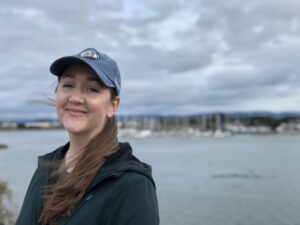
Heather Barrett is the Director of Science Communication at Sea Otter Savvy and a sea otter biologist with more than 12 years of experience in sea otter research, conservation, and outreach. Her work focuses on translating science into meaningful community engagement and stewardship, building partnerships that support coexistence between people and sea otters, and engaging coastal communities in conversations around sea otter recovery. She also leads Sea Otter Savvy’s outreach and engagement efforts in Northern California, connecting science, local perspectives, and community priorities as conversations about the future of sea otter recovery continue.
Shervin Hess, Oregon Zoo’s Conservation Manager

As the Oregon Zoo’s Conservation Manager, Shervin helps restore wildlife populations from salamanders in Crater Lake to elephants in Borneo. Working with Tribes, agencies and nonprofits, he supports species recovery, global partnerships and conservation policy, while engaging communities through storytelling and action. An Iranian-American, he has also contributed to conservation efforts in his motherland.
Kayla Fratt, Co-Founder of K9 Conservationists
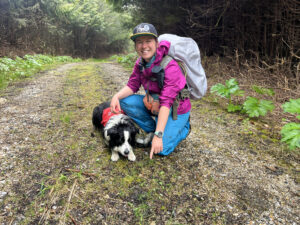
Kayla Fratt is a PhD student at Oregon State University and the co-founder of K9 Conservationists. She has been training and handling conservation detection dogs since 2019. Alongside dogs Barley, Skipper, Niffler, Tooma, and Victoria she has spent 3 years collecting nearly 3,000 wolf scat samples to track wolf diet and movement.
Ellen Dymit, PhD candidate in Wildlife Sciences at Oregon State University

Ellen Dymit is a PhD candidate in Wildlife Sciences at Oregon State University, where her research focuses on coastal carnivore foraging and population ecology. She has led projects across four Gulf of Alaska national parks—Katmai, Lake Clark, Kenai Fjords, and Glacier Bay—and is now developing non-invasive molecular genetic tools to study wild sea otters in Alaska and the Pacific Northwest.
Lily Maynard, Vice President of Conservation Impact at the Cincinnati Zoo & Botanical Garden

Lily Maynard, Ph.D., is the Vice President of Conservation Impact at the Cincinnati Zoo & Botanical Garden, an active partner of the Elakha Alliance. Spending years in zoos, including working as a conservation manager at Disney’s Animal Kingdom, instilled her passion for wildlife. Lily received her B.A. in Biology from Smith College and completed her master’s in Wildlife Ecology and Conservation and doctorate in Interdisciplinary Ecology at the University of Florida. Her research focuses on collaborative conservation, behavior change, and strategic impact for wildlife. She has worked in Africa, Asia, and the Americas on community-driven projects. She strives to follow communities’ lead by asking what support or resources they need and facilitating improvement for their livelihoods in tandem with conservation to help wildlife and people thrive together.
Jacob Sandler, Wildlife Services Coordinator and Certified Wildlife Control Operator
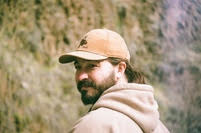
Jake received his Bachelor’s Degree in Environmental Studies with an emphasis on Natural History and Conservation from U.C. Santa Cruz, inspired by a childhood spent exploring the redwood forests, mountains, and shorelines of Northern California. After leaving California he spent a few years living and working in Alaska, finally settling in Bend in 2017. He joined Think Wild as the Wildlife Services Coordinator in November of 2023 and is thrilled about the unique opportunity to help facilitate wildlife conflict mitigation and habitat management with his local community and neighbors. In his free time Jake can be found mountain biking, skiing, playing guitar and relaxing by any of Central Oregon’s stunning lakes or rivers with his wife and two dogs.
Gabriel Jurado, Hoffman Coexistence Science fellow with the Elakha Alliance and the Cincinnati Zoo and Botanical Gardens

Gabriel Jurado is in his final year at Oregon State University studying oceanography and biological data sciences and is a Hoffman Coexistence Science fellow with the Elakha Alliance and the Cincinnati Zoo and Botanical Gardens. He is interested in sea otter reintroduction and helping tribal communities restore historical and cultural connections to sea otters. By using both his traditional knowledge and western knowledge, he hopes to bring a different perspective in natural resource restoration in his tribe.